
GPSF Feature Story
Developments Shaping Policy Debates
Pakistan’s Tourism Promise: Turning Potential into Progress
Tourism as a Pillar of the Global Political Economy
Tourism today sits at the intersection of economic growth, employment, connectivity, and national image-building. Travel and tourism contributed $10.9 trillion to global GDP in 2024, representing around 10 per cent of total global economic output. The sector supported approximately 357 million jobs worldwide, or one in every ten jobs, making it one of the largest employment generators across developed and developing economies alike. International visitor spending recovered to nearly $1.9 trillion, while domestic tourism accounted for over $5.3 trillion, highlighting the sector's dual importance for foreign exchange earnings and internal economic circulation. These figures explain why tourism is increasingly treated not as a discretionary service sector, but as a strategic component of national economic resilience and post-crisis recovery.
How Major States Monetize Tourism
Leading economies convert the tourism flows into sustained national income through scale, efficiency, and policy coherence. In the United States, travel and tourism generated approximately $2.6 trillion in 2024, contributing around 8-9 per cent of GDP and supporting millions of jobs across transport, hospitality, entertainment, and services. China’s tourism sector added roughly $1.6 trillion, close to 9 per cent of GDP, driven by vast domestic travel and expanding international connectivity. In Europe, Germany’s tourism contribution exceeded $525 billion (around 11 per cent of GDP), while Spain derived about 12-13 per cent of its GDP from tourism, and Thailand close to 20 per cent, reflecting deep integration of tourism into national economic models. The success of these cases is based on regulatory clarity, sustained investment, and long-term branding.
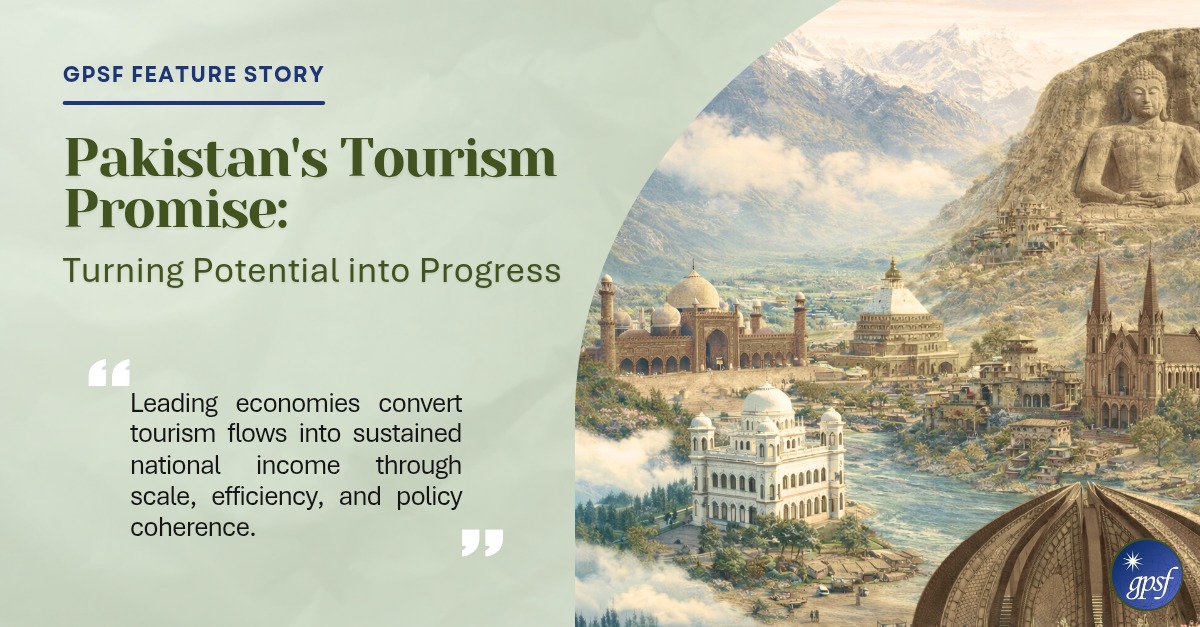
"Leading economies convert tourism flows into sustained national income through scale, efficiency, and policy coherence."
Global Best Practices: What Works and Why
High-performing tourism states share identifiable policy patterns. First, institutional coordination, as successful states align federal and sub-national authorities under unified tourism strategies, ensuring consistent standards and branding. Second, connectivity – modern airports, efficient road and railway networks, and streamlined visa regimes – which directly determines tourist volume and spending. Third, environmental regulation, which has become central, as over-tourism, unmanaged construction, and ecological degradation now undermine destinations faster than security risks. Finally, security assurance and crisis management – tourist police, rescue services, and clear emergency protocols – play a decisive role in shaping travel advisories and insurance costs.
Together, these factors explain why some countries convert tourism into double-digit GDP contributions while others stagnate despite natural advantages.
Pakistan’s Tourism Situation: Progress with Limits
Pakistan's tourism industry has gained international recognition, including from the United Nations World Tourism Organization (UNWTO), which identified Pakistan as a top tourist destination for 2023. The country possesses exceptional tourism assets – mountain ranges, archaeological heritage, religious sites, coastline, and ecological diversity – yet these remain structurally under-leveraged.
Economically, the travel and tourism sector contributed 5.9 per cent to GDP and 4.2 million jobs in 2022, a sub-optimal outcome given Pakistan's vast potential. Visitor spending reached $16 billion in 2022 and is projected to rise to $30 billion by 2033. The sector today supports nearly five million jobs, largely driven by domestic tourism, which generated approximately PKR 3.85 trillion in spending. However, international tourism remains modest, with earnings of roughly $738 million and around 965,000 foreign tourists in 2023 – low as compared to tourist inflows to regional destinations like Thailand (28.15 million), Malaysia (20.14 million) and Indonesia (11.68 million). While strong domestic demand provides a solid foundation, expanding international tourism remains essential for deeper integration into global tourism circuits and for unlocking Pakistan's full growth potential.
Structural Constraints Holding Back Growth
Tourism underperformance is not due to lack of demand, but systemic bottlenecks. Governance remains fragmented across federal and provincial authorities, resulting in uneven standards, inconsistent regulation, and weak destination management. Infrastructure gaps persist at high-value sites – particularly all-weather access, sanitation, emergency services, and regulated accommodation. Environmental pressures are growing as visitor numbers rise without parallel waste management and zoning controls. Moreover, although internal security has improved substantially, external perception lags reality; tourism remains uniquely vulnerable to negative narratives, advisories, and isolated incidents. These constraints collectively suppress international arrivals and limit average tourist spending.
Emerging Enablers: CPEC, SIFC, and Green Tourism
Recent initiatives provide Pakistan with tools it previously lacked. China-Pakistan Economic Corridor (CPEC)-enabled infrastructure, including the upgraded Karakoram Highway and improved access to tourism hubs including Skardu, Gilgit, and Gwadar, has reduced physical isolation of key destinations.
The Special Investment Facilitation Council (SIFC) has prioritized tourism by harmonizing regulations, streamlining approvals, and integrating tourism into broader investment and development policies. Operating under SIFC, Green Tourism Pakistan Limited (GTPL) aims to go beyond facilitation by embedding policy integration and sustainability while promoting renewable energy use, environmental safeguards, eco-lodges, regulated camping, and destination stewardship. These mechanisms can create an institutional backbone for scaling tourism responsibly rather than through ad-hoc growth.
How Pakistan Can Close the Gap
To approach global benchmarks, Pakistan must transition from volume-driven domestic tourism to value-driven, diversified tourism. This requires the development of model destinations – particularly along the Makran coast and in northern hubs – anchored in regulated construction, professional service delivery, and visible safety and rescue frameworks. Equally critical is workforce development: trained guides, hospitality managers, rescue personnel, and cultural interpreters directly enhance service quality, visitor confidence, and per-capita tourist spending.
Aligning tourism development with the Sustainable Development Goals (SDGs) – the United Nations’ 17-goal policy framework for inclusive growth, environmental protection, and climate action – and with Environmental, Social, and Governance (ESG) standards, which guide global investment decisions, can significantly expand access to long-term international capital.
Such alignment is increasingly decisive for external and local partners and institutional investors, for whom sustainability, governance quality, and risk management are now central to investment viability rather than peripheral considerations.
Strategic Outlook
International experience suggests that tourism contributions of 7-8 percent of GDP are achievable within a decade where governance coherence, infrastructure, security signaling, and sustainability converge. Pakistan’s current trajectory, supported by SIFC governance clarity and CPEC connectivity, makes this a realistic, not aspirational, target.
What will shape the debate going forward is whether Pakistan treats tourism as a strategic economic sector – planned, regulated, and protected – or allows growth to remain fragmented and perception-driven. The policy choices made now will determine whether tourism becomes a durable engine of national prosperity or remains a partially realized promise.