
GPSF Feature Story
Developments Shaping Policy Debates
South Asia's Asymmetric Strategic Order Until 2025 &
Pakistan's Nuclear Posture
Preamble
South Asia's security environment is shaped by enduring strategic asymmetries, historical legacies, and evolving deterrence doctrines. Pakistan's nuclear policy emerged as a direct response to a deteriorating regional balance following India's 1974 nuclear test, which altered South Asia's security calculus. From its inception, Pakistan's strategic program was conceived as a deterrent instrument rather than a tool of coercion or warfighting. This orientation has been reflected in the adoption of Credible Minimum Deterrence, a doctrine designed to prevent conflict by ensuring survivability and proportionality rather than numerical or technological parity.
Central to this posture is a centralized command and control system operating under clearly defined legal and constitutional authority. Pakistan's nuclear decision-making structure integrates civilian oversight, military professionalism, and procedural safeguards intended to ensure control, safety, and restraint. These arrangements align with internationally recognized principles of nuclear governance, including separation of custodial functions, layered authorization mechanisms, and strict security protocols.
Likewise, Pakistan's civil-military relations are structured within a constitutional framework that delineates authority, responsibility, and accountability. The Armed Forces operate as state institutions subject to civilian direction and legal mandate, with national security decision-making embedded in formal processes rather than ad hoc improvisation. This institutionalization has contributed to continuity and predictability in strategic behavior.
Operational experience during regional crises provides insight into how systems function under stress. Episodes involving conventional escalation, accidental incidents, and signaling challenges demonstrate a consistent emphasis on crisis management and escalation control. Rather than translating crises into political leverage, Pakistan's responses have largely reflected a calibrated approach aimed at preserving deterrence stability while avoiding uncontrolled escalation.
In contrast, India's evolving force postures and doctrinal signaling, marked by counterforce temptations, offensive conventional concepts, and growing integration of dual-capable delivery systems, have increasingly compressed decision-making timelines and injected instability into the regional deterrence equation.
The crisis dynamics of 2025 underscored this divergence in strategic behavior: while India sought to externalize escalation through calibrated coercive signaling and risk-acceptant posturing, Pakistan employed measured responses, tight command discipline, and deliberate communication to prevent horizontal or vertical escalation.
This GPSF Feature Story presents Pakistan's nuclear posture as a defensive and stabilizing response to regional dynamics rather than an aberration within the international system. By examining doctrine, command structures, and observable practice, it underscores the importance of context, proportionality, and institutional maturity in assessing deterrence behavior. A balanced understanding of South Asia's security landscape requires moving beyond inherited assumptions toward an analysis rooted in structure, intent, and empirical conduct.
Civil-Military Compact in Pakistan
The Pakistan Armed Forces function under constitutional authority and in full coordination with the civilian government. They are institutionally integrated into decision-making processes through bodies such as the National Security Committee and the Cabinet Committee on Defense. Far from existing outside the political system, the military remains one of Pakistan's most structured, accountable, and professionally disciplined institutions, contributing to both internal stability and national resilience.
Military leadership has consistently articulated a vision centered on economic revival, regional stability, and cooperative security. It is united with the civilian leadership on key issues including counterterrorism and regional cooperation. Policy initiatives such as major counterterrorism operations like Zarb-e-Azb and Radd-ul-Fasaad, the Special Investment Facilitation Council (SIFC), and Pakistan's participation in multinational training frameworks with Western and regional partners illustrate an operational focus on peace enforcement, capacity-building, and modernization, not militarized adventurism.
Civil-military coordination in Pakistan has strengthened significantly with time, reflecting a maturing institutional harmony and balance in policymaking domains spanning economic reform, border management, and national security. In comparative perspective, regional trends of military politicization elsewhere underscore the value of Pakistan's constitutional safeguards, professional command ethos, and structured oversight mechanisms as stabilizing features rather than anomalies.
From Peaceful Atom to Nuclear Exceptionalism
Pakistan's nuclear deterrent evolved not in isolation but as a direct consequence of regional developments that had disrupted the strategic equilibrium in South Asia. The 1974 nuclear explosion conducted by India – deceitfully repurposing technology and material acquired under the peaceful "Atoms for Peace" program – constituted a breach of international trust and eroded the foundation of regional stability. In the aftermath, Pakistan was compelled to pursue a defensive capability to restore deterrence balance and ensure its national survival. Thus, Islamabad has maintained a modest, India-centric posture, with warheads sized strictly for deterrence and missile ranges limited to its territories.
From its inception, Pakistan's nuclear policy has been anchored in the principle of Credible Minimum Deterrence – a posture designed not for parity or coercion, but for security and restraint. Every stage of its development has been guided by legal oversight, institutional transparency, and international engagement. All civilian nuclear reactors operate under International Atomic Energy Agency (IAEA) safeguards, and Pakistan has voluntarily expanded the number of facilities under monitoring to enhance confidence in its commitment to non-proliferation norms.
Pakistan's institutional framework is codified in the National Command Authority Act of 2010, which establishes a clear chain of command, ensures civilian chairmanship, and mandates stringent safety and security protocols. This is a threshold-based system, not a hair-trigger doctrine. Institutional design is codified law. The NCA's executive arm, the Strategic Plans Division (SPD), integrates military, scientific, and civilian expertise to guarantee centralized control, custody, and accountability of all nuclear assets.
International recognition of Pakistan's nuclear safety and security record, including repeated affirmations by the IAEA and independent global experts, reflects the maturity and reliability of its command and control infrastructure. Pakistan's stewardship of its strategic assets thus represents a model of disciplined governance within the developing world's nuclear community.
Command, Control, and Crisis Behavior
Pakistan's command and control system adheres to internationally recognized best practices, incorporating multi-layered authorization mechanisms, a two-person rule for critical operations, and specialized training regimes for personnel entrusted with sensitive responsibilities. Regular safety audits, peer reviews, and technical evaluations are conducted to ensure compliance with evolving standards of nuclear security and operational reliability.
Regional Stability Challenge
Against the abovementioned backdrop, South Asia's strategic instability is marked by India's continued interest in maintaining a parallel network of unsafeguarded nuclear facilities, enabling potential diversion of fissile material to its weapons program, an issue highlighted in multiple international assessments. India's delivery arsenal continues to expand toward intercontinental reach, with Agni-V approaching 8,000 kilometers, Agni-VI projected at 12,000 kilometers, and K-series submarine missiles nearing similar ranges.
The BrahMos missile misfire in March 2022 exposed serious procedural lapses within India's strategic systems. A nuclear-capable missile launched from Indian territory inadvertently entered Pakistani airspace without prior notification – an occurrence unprecedented between two nuclear-armed neighbors. The missile misfire constituted a violation of one of the few operational confidence-building measures (CBMs) between India and Pakistan, the Agreement on the Pre-Notification of Flight Testing of Ballistic Missiles (2005), which was designed to prevent precisely such incidents and reinforce crisis stability.
Pakistan's measured and professional response – tracking the trajectory, lodging a formal protest, and refraining from retaliatory action – averted escalation and underscored its commitment to crisis stability. India's subsequent acknowledgment of the episode as a "technical malfunction" reinforced concerns about the reliability and oversight of its command and control apparatus. Pakistan's restraint preserved stability in the face of a live-weapon intrusion.
Brinkmanship, Unsafe Stockpile, and Opacity
Law-enforcement and open-source reports recorded more than 18 confirmed incidents of uranium theft, radioactive material loss, or illicit trafficking inside India between 1994 and 2024. Notable cases include the seizure of 8 kilograms of uranium in Tamil Nadu (1998); the disappearance of a uranium container from an eastern Indian facility (2006); the recovery of 6.4 kilograms of uranium from a black-market network in Jharkhand (2021); and the interception of californium, a highly radioactive isotope, in Bihar (2024). These indicate systemic weaknesses in India's nuclear security governance.
The inadvertent BrahMos missile launch, coupled with repeated reactor leaks and safety violations, further underscores these vulnerabilities. When viewed alongside the political radicalization, democratic backsliding, and institutional polarization associated with Hindutva-driven politics, these trends compound global concerns about the safety and responsible stewardship of India's nuclear stockpile, heightening the risk of extremist influence within its strategic ecosystem.
India's opacity compounds the challenge. While publicly professing a "No First Use" (NFU) policy, New Delhi continues to invest in counterforce capabilities. Even before May 2025, a cross-national scholarly debate highlighted India's counterforce temptations: the accumulation of precise delivery systems, multiple-independently-targetable re-entry vehicles (MIRVs), missile defenses, ISR improvements, and pre-emptive strike doctrines, all of which dilute the credibility of its declaratory restraint, and taken together, could support a repertoire of pre-emptive options. The most-cited synthesis is by Clary and Narang in International Security. Their analysis has been contested (e.g., by Indian strategists who see insufficient proof of doctrinal shift), but the debate itself – spanning MIT's open-access archive, ORF critiques, and subsequent academic work – underscores a real-world ambiguity that compresses crisis timelines and blurs conventional-nuclear boundaries. India's signaling and force-structure choices as eroding NFU's constraining value and drifting toward flexible counterforce.
Pakistan's nuclear posture remains institutionally centralized, ideologically neutral, and professionally managed as a state-controlled deterrent system. The NCA Act 2010 and SPD protocols legally and technically preclude any delegation of launch authority to field commanders. Personnel assigned to sensitive duties undergo multi-tier vetting and continuous evaluation, ensuring integrity and accountability at every level of the custody chain.
In practice, India's evolving posture mirrors the very brinkmanship it attributes to Pakistan, highlighting the need for balanced analysis grounded in verifiable data rather than inherited narratives.
Disinformation as Policy
Contemporary scholarship increasingly acknowledges that narrative dominance has evolved into an extension of strategic competition in South Asia. Narratives that portray Pakistan's security institutions as politically interventionist or strategically reckless often recycle dated accounts rooted in rivalry rather than empirical assessment. Such framings obscure the structural drivers of instability in South Asia, foremost among them, India's continued reluctance to resolve the Jammu and Kashmir dispute in accordance with UN resolutions, its repeated cross-border violations, support for proxies, and introduction of nuclear weapons into the region in 1974 under the guise of a "peaceful" test.
Pakistan, despite enduring provocation, continues to seek dialogue and normalization with India on all outstanding disputes. India, however, has often opted for escalation, selective propaganda, and the externalization of internal crises, particularly in Jammu and Kashmir, to avoid meaningful engagement. Incidents such as Mumbai (2008), Pathankot (2016), Pulwama (2019), and Pahalgam (2025) exhibit strong indicators of orchestrated or misattributed events that served to deflect domestic scrutiny and vilify Pakistan in global discourse.
Similarly, unrest in Pakistan's Balochistan province is driven not by popular dissent but by a small network of India-backed terrorist proxies such as the Balochistan Liberation Army (BLA), whose violence targets both civilians and institutions. The Baloch people remain victims of these foreign-sponsored disruptions.
Following the May 2025 crisis, coordinated disinformation campaigns sought to portray Pakistan as unstable while normalizing India's drift toward pre-emptive military options. This reflects the growing use of information warfare as a deliberate instrument of deterrence signaling and political coercion.
Taken together, these patterns indicate that disinformation has become a structured element of India's statecraft, used to justify pre-emption and undermine Pakistan's deterrence credibility. Countering this trend requires renewed emphasis on evidence, transparency, and dialogue as foundations of regional stability.
Crisis Learning and the May 2025 Conflict
No independent or multilateral investigation has conclusively established responsibility for the Pahalgam incident to date. Nevertheless, India initiated Operation Sindoor, employing stand-off munitions, drones, and precision airstrikes against Pakistani territory – actions that marked a dangerous escalation between two nuclear-armed states. However, India's attempt to rebrand deep, pre-emptive cross-border strikes as stabilizing practice did not survive the crisis.
Independent international analyses, including the International Institute for Strategic Studies (IISS), the Center for Strategic and International Studies (CSIS), and the International Crisis Group (ICG), have characterized the episode as the most serious India-Pakistan escalation in decades, marked by air, missile, and drone strikes over several days and differing and disputed narratives of who did what, when.
Nonetheless, this was not normalization but the institutionalization of brinkmanship, where compressed decision timelines magnify misperception and increase the premium on proof over performative signaling. Subsequent independent assessments also indicated that Indian false claims of operational success were amplified for domestic consumption as it engaged in controlled narrative management to maintain internal legitimacy.
Throughout the crisis, Pakistan's conduct reflected strategic restraint and institutional discipline as well as credibility. Official statements emphasized the need for a neutral investigation into the Pahalgam attack, the imperative of avoiding escalation beyond tactical thresholds, and the maintenance of communication channels to facilitate de-escalation. Far from seeking confrontation, Pakistan pursued stability through credible denial, calibrated deterrence, and responsible signaling.
The 2025 confrontation provided the enduring lesson that evidence must precede attribution. In an era increasingly shaped by deepfakes, AI-generated disinformation, and polarized media ecosystems, policymaking grounded in unverified narratives risks transforming perception into peril and rhetoric into real war.
Raising Thresholds in Practice
In August 2025, Pakistan further strengthened its deterrence management architecture through the establishment of the Army Rocket Force Command (ARFC). The new command consolidates conventionally armed rockets and missiles under a distinct chain of command, thereby raising the nuclear threshold and minimizing the risk of inadvertent entanglement between conventional and strategic systems. Independent reporting by Reuters and Arab News confirmed the formation of the ARFC, while defense analyses including Janes and Associated Press documented the maturation of the Fatah family of precision-guided rockets that populate its conventional portfolio.
This institutional reform aligns with long-standing international recommendations advocating "firebreaks" between nuclear and conventional forces, an essential safeguard when crisis timelines compress and misinterpretation risks escalate. By clearly differentiating command structures and operational roles, Pakistan's ARFC enhances transparency, signal clarity, and crisis stability. In design and effect, it represents precisely the kind of doctrinal and organizational firewall that global stability advocates have urged nuclear states to adopt.
Policy Recommendations
A balanced approach to South Asian deterrence requires abandoning moral binaries that portray one actor as "responsible" and the other as "rogue." Pakistan's nuclear program operates within a clearly defined legal and institutional framework, supported by civilian oversight, professional command structures, and internationally acknowledged safety measures.
The international community would contribute more effectively to stability by applying equal scrutiny to all regional actors, particularly given the recurring incidents of uranium theft and missile malfunctions in India, and by promoting reciprocal transparency measures under the UN and IAEA frameworks rather than coercive, one-sided conditionalities.
For Pakistan, the strategic path forward lies in continuing to strengthen institutional transparency and crisis-communication mechanisms. Expanding engagement with international think tanks and diplomatic forums can help counter misinformation and build confidence in Pakistan's responsible stewardship of nuclear technology. Sustaining public emphasis on legal oversight, proportionality, and Credible Minimum Deterrence reinforces the country's identity as a disciplined and law-bound nuclear state.
For India, genuine stability will require a recommitment to verifiable restraint. New Delhi should clarify doctrinal ambiguities surrounding its NFU pledge, permit neutral reviews of its nuclear safety practices following repeated radioactive thefts, and delink domestic political narratives from military signaling. Responsible deterrence cannot coexist with opacity and politicization.
Finally, global scholars and media analysts have a central role in de-escalating the narrative contest. Academic and journalistic assessments must rest on verifiable data, not inherited assumptions or partisan framings. Sustainable stability in South Asia depends on both nuclear powers being treated with fairness, analytical precision, and equal respect under international norms.
Strategic Outlook
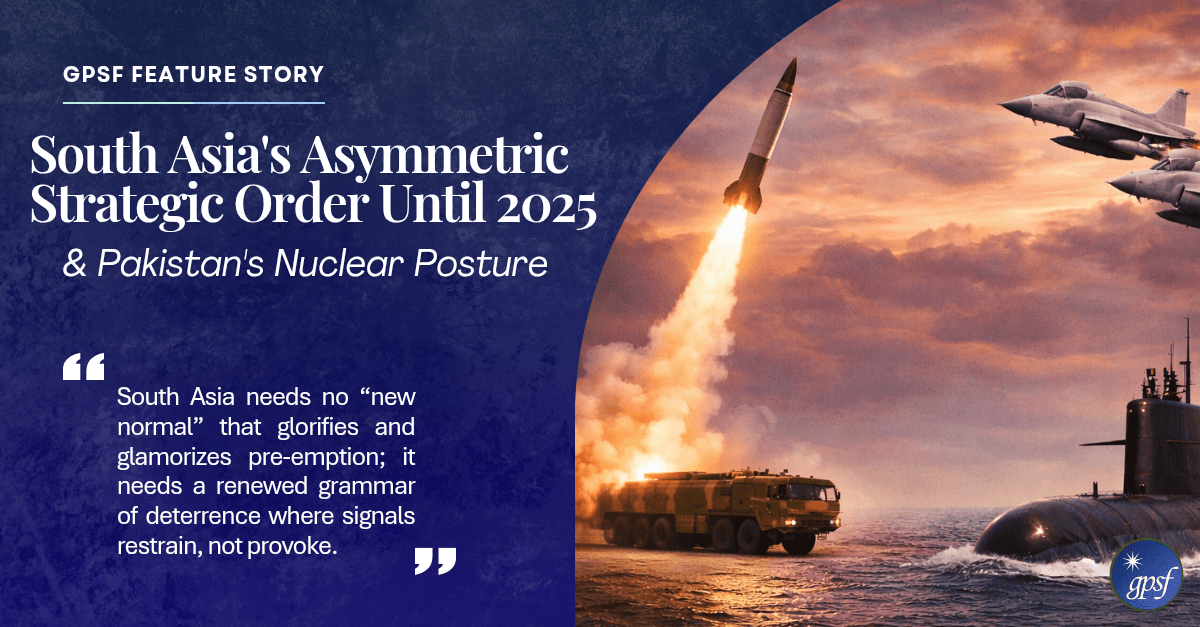
"South Asia needs no 'new normal' that glorifies and glamorizes pre-emption; it needs a renewed grammar of deterrence where signals restrain, not provoke."
Across legal frameworks, doctrinal debates, and observed crisis behavior. The policy implications are therefore straightforward: preserve symmetry, prioritize verification before attributing blame, and maintain conventional firebreaks to keep escalation thresholds high. Enduring stability in South Asia will rest not on unilateral narratives or insulated echo chambers, but on symmetry, transparency, and accountability – principles that apply equally to all parties. Pakistan's position in this regard remains consistent: its deterrence posture is defensive in purpose, centralized in control, and stabilizing in intent.