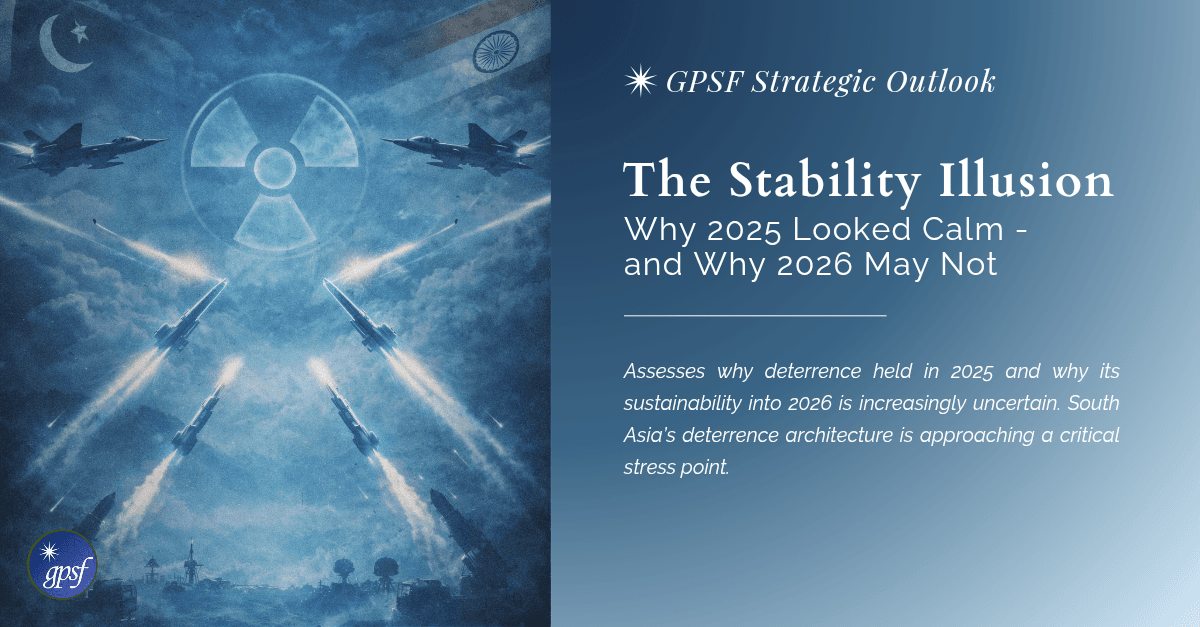
The Stability Illusion: Why 2025 Looked Calm – and Why 2026 May Not.
The Paradox of Calm.
The year 2025 will be remembered as one of the most escalatory in South Asia's nuclear history and, paradoxically, as one that ended without a major war. Air, missile, and maritime forces were placed on alert, dual-capable systems were visibly deployed, and information operations reached a level of orchestration unseen since the 2019 conflict between the two nuclear powers. Despite this, the crisis subsided into uneasy calm, even as India continues to claim that its hybrid war against Pakistan, labelled Operation Sindoor, remains ongoing. This outcome raises a central question: Why did deterrence hold, and what does this reveal about the risks ahead?
The answer lies in Pakistan's restraint. India's evolving doctrine, force posture, and crisis behavior have progressively strained the region's deterrence architecture. Stability persisted not because the system functioned smoothly, but because Pakistan exercised caution within an increasingly fragile framework. The deterrence system thus remained intact only because it was handled with care.
Nonetheless, South Asia's deterrence architecture is approaching a critical stress point. The region remains under growing strain from doctrinal drift, technological entanglement, and the absence of effective crisis-management guardrails. What appeared as equilibrium was, in effect, behavioral containment under pressure. The calm of 2025 was therefore contingent and temporary, not structural. Stability has been maintained on narrow margins. Without structural reinforcement – particularly amid compressed decision timelines and expanding dual-use domains – the next escalation cycle, potentially in 2026, may exceed the region's capacity for restraint.
This GPSF Strategic Outlook, as an end-year assessment with forward policy relevance, deconstructs why deterrence held in 2025 and identifies the risk trajectories most likely to define the next crisis cycle: decision-time compression, dual-use ambiguity across air, maritime, and missile domains, and the weakening of normative firebreaks that once moderated risk.
Why Deterrence Held in 2025 and Why It May Break Down Ahead.
Deterrence held in 2025 because Pakistan exercised measured restraint under intense provocation during the May crisis, triggered by the Pahalgam incident and India's preemptive Operation Sindoor. Pakistan's Quid Pro Quo Plus (QPQ+) response – calibrated, precise, and deliberately limited – restored conventional deterrence while compelling India to seek de-escalation through backchannel diplomacy. Crucially, Pakistan restored conventional deterrence without nuclear signaling, demonstrating institutional maturity through deliberate control rather than doctrinal automatism.
South Asia, however, lacks the institutional shock absorbers that have helped other nuclear dyads manage crises. Unlike regions supported by incident-prevention agreements, de-confliction mechanisms, and operational communication channels, crisis stability in South Asia remains ad hoc. As dual-capable systems, autonomous platforms, and long-range precision weapons proliferate, decision timelines across air, maritime, and missile domains are rapidly compressing – a trend that directly shapes escalation risk beyond 2025.
In 2025, escalation control rested on prudence rather than process. Pakistan's restraint was not passive but architectural. The establishment of the Army Rocket Force Command (ARFC) in August 2025 created a dedicated conventional precision-strike layer, reducing nuclear entanglement and raising escalation thresholds. By contrast, India has accelerated the testing and operational integration of dual-capable missile systems, increasing ambiguity and crisis instability. Continued testing of such systems into 2026 is likely to further erode deterrence stability.
Additional stress comes from external accelerants. India's doctrinal drift toward counterforce options and its expanding sea-based nuclear posture are reinforced by extra-regional partnerships. The Indian Ocean is emerging as a new instability frontier, where unmanned platforms, carrier operations, and ISR assets will increasingly operate without communication protocols, increasing the risk of miscalculation – a risk vector likely to mature, not recede, in 2026.
The result is an illusion of equilibrium sustained by restraint on one side amid systemic fragility. Stability in 2025 was behavioral; calm masked vulnerability rather than reflecting robust design. Without institutionalized firebreaks, a single misread signal in a future crisis could cascade rapidly across domains and outpace diplomatic intervention.
The deeper lesson is that South Asia's deterrence endures through responsible conduct on one side, even as the unreformed framework invites greater peril ahead.
The System Under Stress: Architecture vs. Accelerants.
South Asia's deterrence architecture should prevent war. Pakistan's framework, grounded in Credible Minimum Deterrence, integrates capabilities across tactical, operational, and strategic levels, supported by a command and control system that ensures weapons are always available yet never used inadvertently. In repeated crises, Pakistan has demonstrated that its QPQ+ response can counter aggression and restore deterrence, forming an institutional backbone that has absorbed escalation shocks.
Yet one side's system can only manage, not resolve, systemic imbalance in the region. While Pakistan's deterrence stabilizes crises, the regional system remains structurally strained, leaving persistent risks of escalation.
India's doctrinal evolution over the past decade has shifted it from a cautious nuclear actor to a source of systemic stress. Signals suggesting movement toward nuclear preemption, dilution of its conditional No First Use (NFU) posture, pursuit of counterforce options, and the deployment of dual-capable systems have injected persistent uncertainty into crisis calculations. While calculated ambiguity can instill caution, ambiguity without restraint erodes deterrence credibility. India's signaling, pre-emptive crisis behavior, and force development have created such an environment. If emerging technologies, such as AI-enabled systems, hypersonics, autonomous platforms, and cyber capabilities, are integrated into this posture, deterrence may not hold in future crises.
Besides above, three accelerants amplify this stress. First, New Delhi's blending of so-called 'surgical strike' and 'deterrence by punishment' doctrines blurs the nuclear-conventional divide. Second, hypersonic and MIRV-capable systems, combined with ISR integration partnerships, compress decision time to near-instinctive levels. Third, the ideological 'Hindutva turn' within India's security establishment recasts strategic calculation as moral assertion, eroding bureaucratic caution. Together, these dynamics transform India from participant to accelerant – a force that heats the system faster than its stabilizing mechanisms can cool it.
The Indian Ocean, once peripheral to South Asian crises, is now the epicenter of strategic compression. India's induction of nuclear attack and ballistic missile submarines, its logistics and technological pacts with extra-regional powers, and its deployment of autonomous ISR platforms are producing a deterrence environment without guardrails. No incident-at-sea code or de-confliction protocol governs these encounters. History suggests that once such postures harden, reversal is rare.
Deterrence stability, like goodwill, rests on reciprocity. Accelerating asymmetries indicate that the durability of deterrence will increasingly depend on Pakistan's development of qualitative and matching offsets.
In next crisis, India's expanding maritime capabilities could accelerate escalation by drawing extra-regional powers into a conflict not of their choosing. Incidents involving third-party naval assets – whether accidental or misattributed, as illustrated by India's 2022 BrahMos misfire – would severely test restraint by affected states. Advanced surface- and space-based ISR systems will rarely provide certainty about the source of an attack on submarines, surface vessels, or land assets. Technological sophistication without institutional restraint thus heightens nuclear risk.
Absent frameworks and CBMs, decision timelines will continue to compress. From 2026 onward, the convergence of manned and unmanned assets – autonomous underwater vehicles, unmanned surface vehicles, and AI-assisted ISR nodes – can make misattribution instantaneous and potentially irreversible. Across air, sea, and missile domains, the window between detection and decision is narrowing toward minutes because India and Pakistan have bordering land, air and maritime space. ISR feeds from multiple constellations, automated early-warning systems, and dual-use launchers create an ecosystem where speed substitutes for judgment. In such an environment, deterrence risks becoming an act of faith in algorithmic accuracy.
Structural Erosion of Strategic Restraint.
In a post-2025 environment, restraint may disappear as policy. More so as India's claim of a 'new normal,' its invocation of 'terror responses without verification,' and its growing domestic politicization of military action are normalizing pre-emptive behavior. Deterrence equilibrium built on behavioral moderation cannot endure when political incentives favor escalation.
At the same time, increasing operational integration with other external enablers through foundational logistics and other agreements has expanded India's reach without extending its accountability. Thus, this legal and operational vacuum in the Indian Ocean interacts with ideological radicalization to create a dual deficit: no rules and diminishing incentives for caution.
The 2026 Forecast: Stability at the Breaking Point.
Unless systemic reforms are introduced, the 2026 trajectory points toward an environment where deterrence may not hold by behavior alone. Three destabilizing dynamics are converging.
Pakistan's deterrence design can mitigate risk, but cross-domain stress generated by India may still lead to breakdown. Without regional institutional guardrails – maritime CBMs, joint notification protocols, and verifiable communication channels – behavioral restraint cannot continue to compensate for structural gaps.
Deterrence held during the 2025 crisis, but assuming that stability can persist in an unstructured environment is increasingly risky. While Pakistan's architecture endures, the surrounding strategic environment has become hostile to stability itself. India's convergence of ideology, advanced technology, and strategic opacity has turned deterrence from a stabilizing mechanism into a stress test. If 2025 demonstrated that restraint can avert catastrophe, 2026 may demonstrate the limits of restraint in the absence of reform.
To shift from contingency to stability, India-Pakistan maritime arms control measures are no longer optional but structurally necessary. Without them, security in the Indian Ocean will remain an accident of restraint. Unless structural reforms are introduced, deterrence stability in 2026 will depend on luck.
The lesson of 2025 is misleadingly reassuring: deterrence held. The warning is clearer: it held only once. The calm that followed reflected exhaustion, not equilibrium. While the architecture endured, it did so at high velocity and under strain. South Asia now stands at a narrow inflection point between stability sustained by discipline and breakdown accelerated by overconfidence. One can be corrected; the other may not.
Strategic Takeaway.
The events of 2025 presented South Asia with a dangerous paradox. The region experienced its most acute deterrence crisis in decades, yet escalation to a wider war was narrowly avoided. This outcome has been misread in some quarters as evidence of a resilient and self-correcting nuclear equilibrium. It was neither. What held in 2025 was not systemic stability, but situational restraint exercised within a structurally strained environment. The calm that followed reflected fragility, not balance.
Pakistan's deterrence architecture – centralized, disciplined, and legally anchored – functioned as the principal stabilizing force during the crisis. Institutional control, calibrated response options, and deliberate escalation management absorbed shocks generated by misperception, narrative escalation, and doctrinal ambiguity. India's posture, by contrast, emerged as the dominant stressor. Its counterforce signaling, blurred nuclear-conventional interface, expanding maritime ambitions, and tolerance for opacity have progressively weakened regional stability. The May 2025 crisis underscored how close the region now stands to its limits: crisis averted by professionalism, not by process. No architecture can survive repeated stress when its environment institutionalizes opacity.
The persistent illusion of calm is therefore misleading. Deterrence that depends disproportionately on one side's prudence is inherently unsustainable. Stability cannot endure where incentives reward risk-taking, ambiguity outpaces control, and crisis management relies on ad hoc judgment rather than agreed rules. Without corrective action, deterrence failure in a future crisis, potentially as early as 2026, cannot be discounted.
For policy, the implication is clear: preserving peace in South Asia now requires a shift from reliance on behavioral restraint to structural reform. Institutionalized guardrails, particularly in the maritime domain, mechanisms that slow decision-making, and credible communication frameworks are no longer confidence-building ideals but necessities of survival. Deterrence must be governed, not merely assumed. Pakistan has institutionalized control; the regional order must institutionalize caution. This requires India to internalize stability as a shared interest and its partners to incentivize restraint by discouraging destabilizing force postures and unchecked vertical proliferation.
If 2025 demonstrated that discretion can still rescue deterrence, 2026 may test whether the system itself is capable of doing so. The lesson is not that war was avoided, but how narrowly. The future of stability in South Asia will hinge on whether restraint remains a deliberate choice, or a lesson learnt too late.